

Which family road trip games can keep a six-year-old, a teenager, and two tired adults interested without turning the back seat into a courtroom? The best choices are compact, easy to pause, safe for a moving car, and flexible enough for different ages. This guide focuses on games that passengers can play while the driver concentrates on the road.
Verdict: Choose short, cooperative, low-mess games first, then add competitive games only when your group can handle losing without an argument.
What Makes a Car Game Work for the Whole Family?
A road trip game solves a basic travel problem: passengers have long stretches of waiting with limited space, changing scenery, and uneven energy levels. A game earns its place when it creates interaction without demanding a table, a flat surface, constant reading, or a perfect mood. That standard removes many popular board games from consideration. A game with tiny pieces may work at home but fail after one sharp turn. A game with a forty-minute rulebook may lose younger players before the first round ends.
Verdict: The strongest family road trip games take less than five minutes to explain, last 15 minutes or less per round, and allow a player to pause without ruining the result.
Use the moving-car test
Ask four questions before packing a game. Can players hold every piece in their hands? Can the game continue if one person needs a snack, a bathroom stop, or a nap? Can someone join halfway through? Can the group play without shouting? Card games, verbal games, magnetic boards, and story prompts usually pass this test. Games that require dice to roll across the vehicle, pencils without clipboards, or a large playing surface usually fail it.
Match the game to the real problem
Different games solve different travel problems. A quiet observation game helps when the car feels overstimulated. A cooperative story game helps siblings who compete over every point. A word game gives older children something harder than a simple scavenger hunt. A visual spotting game can occupy several passengers at once, but it may frustrate a child who reads slowly or has difficulty tracking small symbols.
Do not confuse a game that looks educational with one that works in a car. The useful question is not whether it teaches spelling, memory, or geography. The useful question is whether the rules still feel fair after three hours of sitting, heat, traffic, and missed snacks.
How Should You Match Games to Ages, Seats, and Stops?
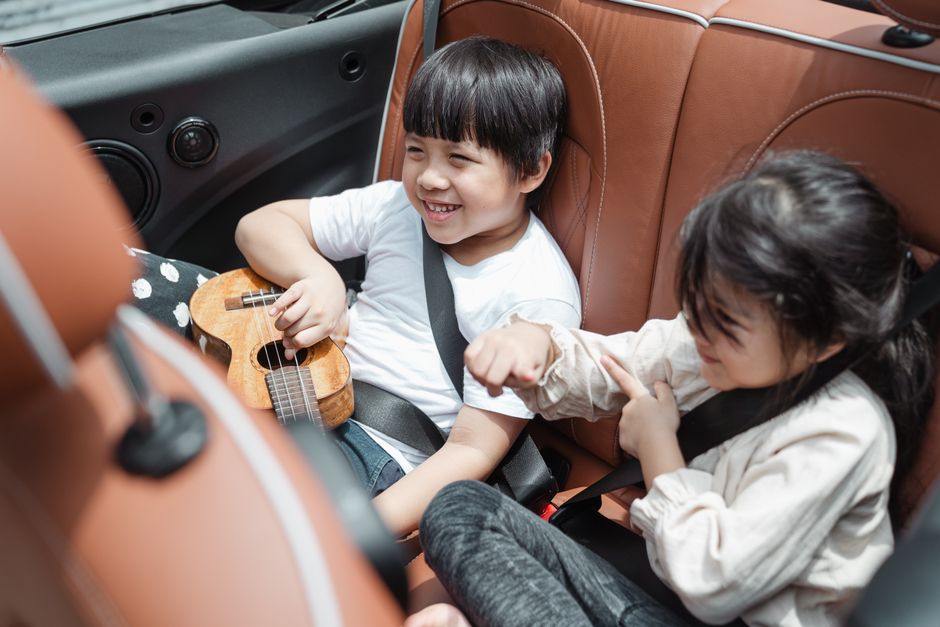
Verdict: Pack games by travel stage, not by age label alone. A preschooler and a teenager can enjoy the same activity when the rules give each person a meaningful role.
- For preschoolers: Choose verbal spotting, color searches, animal counting, and simple picture matching. Avoid games with loose pieces that can become choking hazards. A passenger should supervise all materials, and the driver should never hand items backward while the vehicle is moving.
- For ages six to eight: Add short card games, memory challenges, simple word chains, and story prompts. Use a timer of 10 to 15 minutes so the activity has a natural stopping point.
- For ages nine to twelve: Introduce license-plate categories, geography clues, riddle contests, and cooperative missions. Give older children the job of reading the rules or keeping score, but do not make one child responsible for the entire activity.
- For teenagers: Use games with strategy, humor, or creative control. Let them create the next round, choose the category, or set a challenge for the adults. A game that treats teenagers like toddlers will usually stay in the bag.
- For mixed ages: Use teams instead of individual scoring. Pair a reader with a younger child, or let each team nominate a spokesperson. This reduces the advantage held by the fastest reader or strongest visual spotter.
- For rest stops: Save active scavenger hunts, sidewalk-chalk challenges, and nature searches for outside the vehicle. Never ask passengers to look for objects in a way that distracts the driver or encourages sudden shouting near traffic.
Seat position matters too. A child holding cards needs enough room to see them without leaning into another passenger. If a game requires a flat surface, use it only when the vehicle is parked. A lap desk can become a projectile in a sudden stop, so secure travel gear according to the vehicle and product instructions.
Which Games Are Best for Mixed-Age Families?
My clear pick for the widest age range is Spot It! National Parks. It supports two to eight players, uses a simple matching rule, fits in a tin, and gives younger children a visual theme they can understand quickly. The National Parks edition is listed for ages four and up at $14.95, so it works well when an adult wants to join a preschooler without making an older sibling play a baby game.
Best for competitive families: Spot It! Classic
Spot It! Classic is the better choice when the group enjoys speed and quick wins. Players search for the one matching symbol between cards, and rounds can end before frustration builds. Its $10.99 Eco Blister price makes it an inexpensive second game for a longer trip. The weakness is clear: a fast reader or strong visual spotter may dominate. Use team play or rotate the caller if one person wins every round.
Best for calm, creative play: Rory’s Story Cubes
Rory’s Story Cubes is my choice for families that want conversation instead of competition. The official Asmodee listing gives it a $14.99 price, an age recommendation of six and up, one to twelve players, and an average play time of 15 minutes or less. Players build a story from picture prompts, so a child can contribute one sentence while an adult carries the plot. The tradeoff is that it depends on imagination; a tired child may prefer a structured guessing game.
Best for a parked-car break: Mudpuppy Let’s Take a Swim
Mudpuppy’s Let’s Take a Swim Magnetic Board Game is not my first choice while the car is moving because it needs players to manage a board and spinners. It becomes a strong rest-stop option instead. The portfolio measures 6.75 by 6.75 by 0.5 inches, supports two to six players, and uses magnetic pieces. Buy it when your family wants a compact game for hotels, picnic tables, or waiting areas, not as the only activity for a full drive.
What Common Buying Mistakes Should You Avoid?

Verdict: Do not buy a large, loose-piece game just because its box promises family fun.
The first mistake is ignoring the youngest player who will actually be in the car. A game marked for ages eight and up may be excellent for two adults and two older children but useless when a four-year-old is expected to sit quietly beside it. The second mistake is buying only competitive games. Competition can create energy, but a long trip needs at least one cooperative or open-ended option for the hour when everyone is tired.
The third mistake is assuming a screen-free game needs no preparation. Print category cards, pack a pencil with a clip, place cards in a zip pouch, and read the rules before leaving. The fourth mistake is packing too much. Five games with overlapping rules create clutter; three different formats usually work better: one visual game, one verbal game, and one creative or word-based game.
Know when not to buy a travel game at all. If your passengers get carsick when reading or looking down, choose spoken games such as twenty questions, alphabet categories, or story building. If the trip includes frequent stops, a nature scavenger hunt may work better than a boxed game. If your family already argues over scorekeeping, skip competitive products and use cooperative prompts instead. The cheapest option may be a homemade list of road signs, animals, colors, and unusual buildings, provided the driver does not participate while moving.
What Is the Simple Game Plan for a Long Drive?
Verdict: Pack one game for connection, one for quiet focus, and one backup activity that requires no pieces.
Before departure
Put each activity in its own labeled pouch. Check that every card, tile, marker, and instruction sheet is present. Decide who can reach each pouch, and keep the rest in a bag that stays closed during the drive. Explain that the driver has no role in choosing cards, keeping score, or settling disagreements.
During the first hour
Start with a low-pressure verbal game while everyone is still settling in. After a meal or rest stop, use a short card game such as Spot It! Classic for passengers who want competition. When energy drops, switch to Rory’s Story Cubes or a homemade story chain. A change of format often works better than repeating the same game until everyone dislikes it.
When the group is tired
End the activity before the argument begins. Offer music, an audiobook, quiet looking, or sleep. The purpose of road trip games is not to fill every minute. It is to create a few good stretches of shared attention without adding pressure to a difficult journey.
The single most important takeaway is to choose short, low-mess games that passengers can pause safely, because the best road trip game is the one that makes the ride easier for everyone.